The quick version
- You can go inside by boat or kayak, but since August 13, 2024 nobody may land on the beach inside the cave or swim in.[1]
- Inside, the cave is roughly circular and about 50 metres across, with a domed ceiling 15 metres up.[2]
- A private yacht cruise from Portimão reaches the cave and takes 2.5 - 6 hours as a private group.[3]
- Trips range from a 75-minute sunset cruise to a 2.5 - 6 hour private yacht.[3][4]
- Swell and wind decide whether boats enter. Keep a spare day free if the sea turns rough.
- Top choice Private Yacht, Benagil from US$545 Duration2.5 - 6 hours[3]LanguagesEnglish, French, Portuguese, Spanish[3]Rating4.74 from 1,768 reviews[3]CancellationFree up to 24 hours before[3] Check availability
- Benagil Sea Cave Speedboat from US$14 Duration1.5 hours[5]LanguagesEnglish, Spanish, French, Portuguese[5]Rating4.81 from 7,820 reviews[5]CancellationFree up to 24 hours before[5] See this tour
- Benagil Sunset Cruise from US$13 Duration75 minutes[4]LanguagesSpanish, English, French, Portuguese[4]Rating4.81 from 2,545 reviews[4]CancellationFree up to 24 hours before[4] See this tour
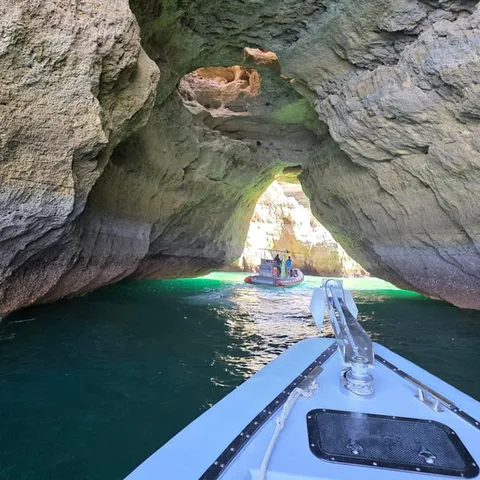
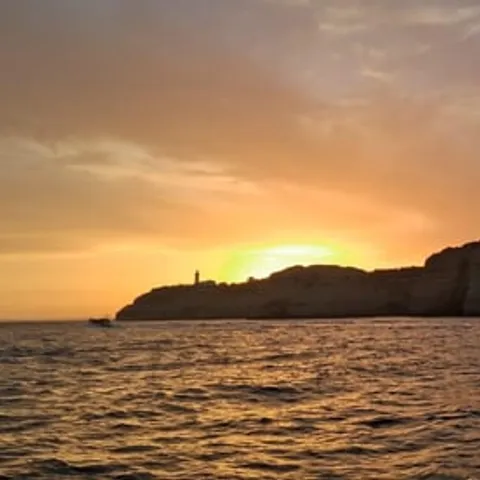
As of August 13, 2024, visitors will no longer be allowed to disembark onto the beach inside the Benagil Cave or swim into it.
Go for the water, not the beach
Before reserving
Can You Go Inside Benagil Cave?
Yes. Boats, kayaks and paddleboards still bring people into Benagil Cave, and you can look up at the famous opening from the water. What you cannot do is get out onto the sand. Since August 13, 2024, visitors are no longer allowed to disembark onto the beach inside the cave or to swim into it.[1] The restriction applies to all visitors whatever their means of arrival, so a private yacht and a rented kayak meet exactly the same rule.[1] You come in, you float, you look, and you leave the way you arrived.
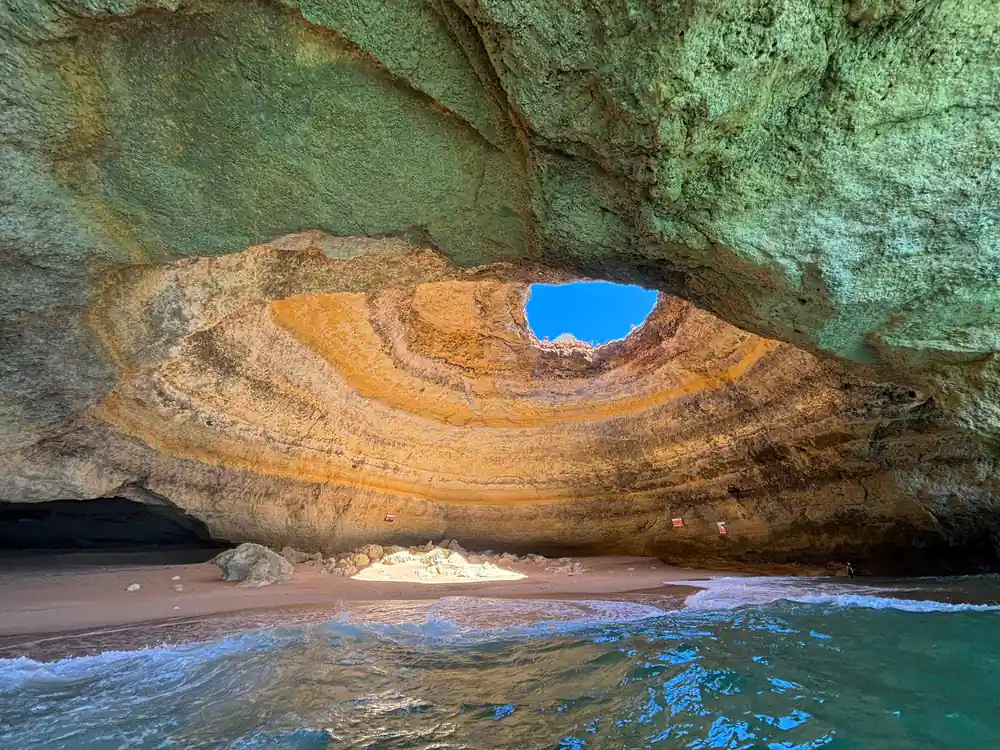
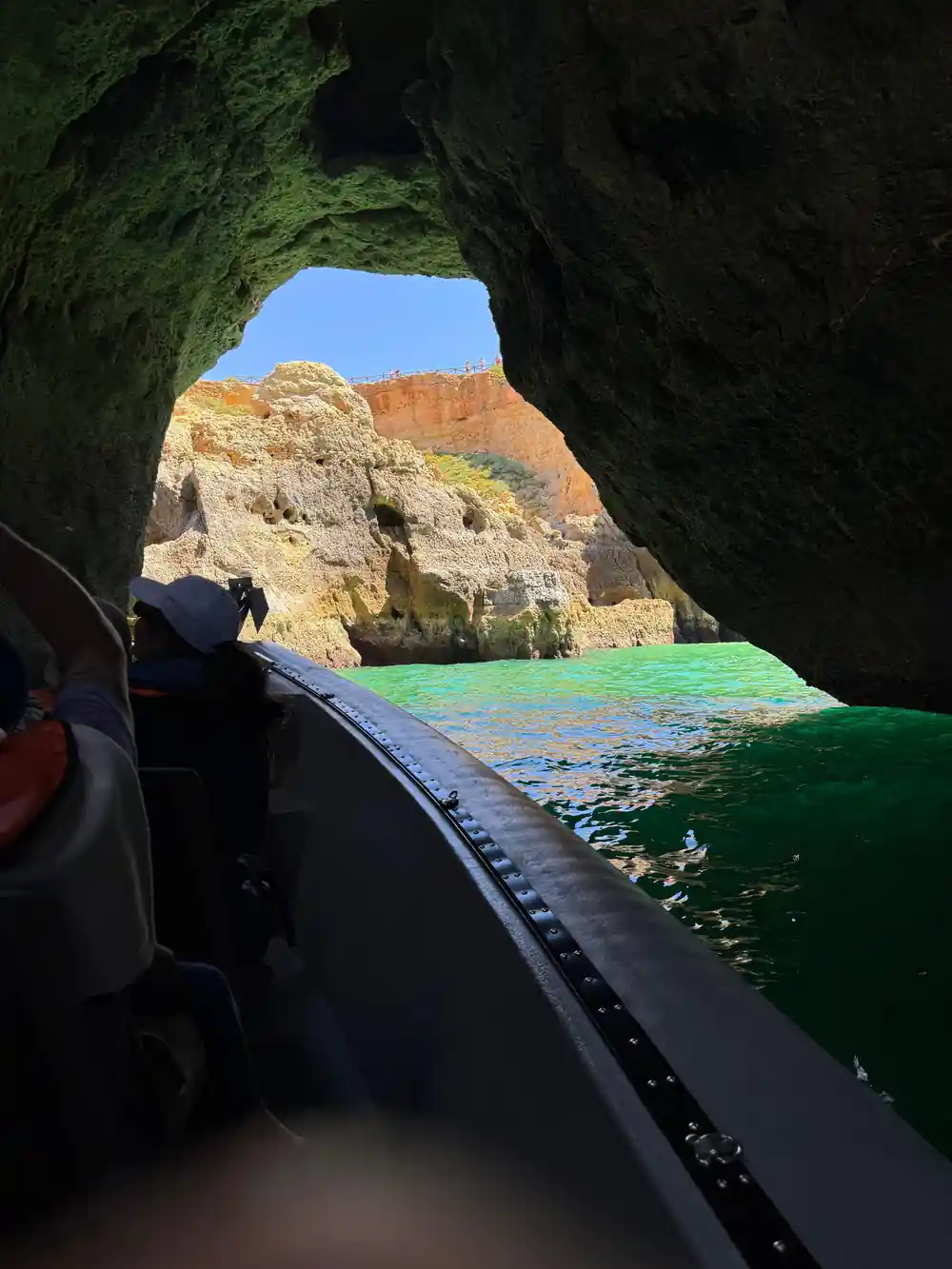
It helps to know the shape of the place before you arrive. The interior of the cave is roughly circular and about 50 metres across, with walls rising 15 metres to a domed ceiling.[2] At the top of that dome the rock has opened completely into an oval roof opening about 10 metres across.[2] That opening is the picture everyone wants: a bright disc of sky above dark green water, with the walls curving around you in bands of orange, gold and grey. From a boat you feel the swell lift you as you cross the entrance, and under the dome the sound of the engine comes back at you from above.
What Changed in August 2024
The classic Benagil photograph was taken standing on the sand at the back of the cave, looking up at the round opening. That shot is now out of reach. From August 13, 2024, visitors are no longer allowed to disembark onto the beach inside the cave or to swim into it.[1] The rule covers the interior beach and swimming in, and it applies to everyone, whatever their means of arrival.[1] A yacht passenger, a speedboat passenger and a kayaker all meet the same restriction.
In practice, every cave trip is now a viewing trip. You pass through the entrance, drift or motor around the inside for a few minutes, take your photographs, and head back out to the coast. The itinerary is the coastline itself: arches, sea stacks, smaller grottoes and beaches on either side of Benagil, with the cliffs of the Algarve rising behind them. If you were hoping to stand on the sand under the opening, that is the expectation to reset before you book.
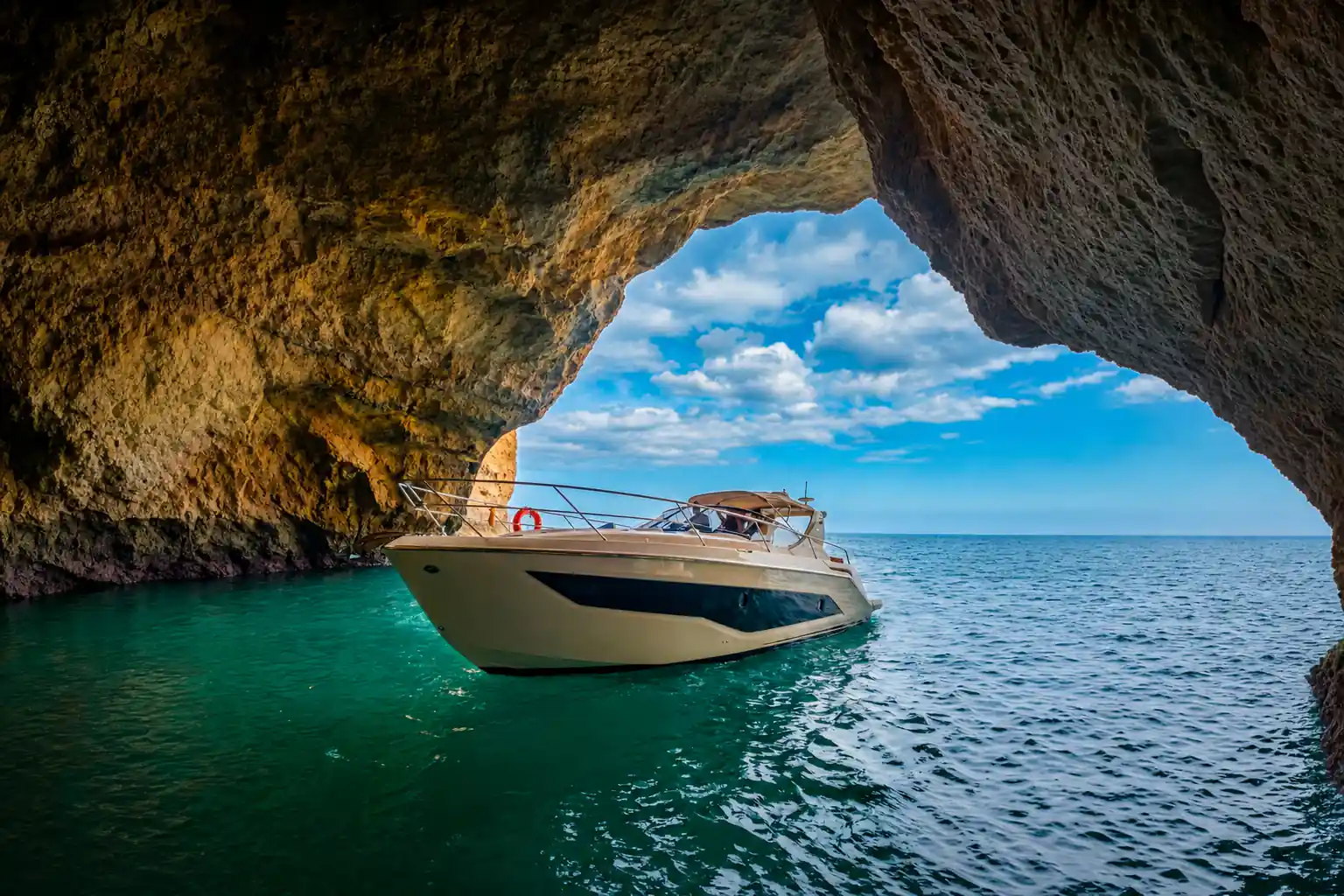
The oval roof opening drops a disc of light onto the water inside the cave.
The Cave Itself: Rock, Light and Scale
Benagil is a sea cave cut into a limestone coast. The Algarve coastline here is limestone-dominated, and the cave was formed over millions of years by coastal erosion.[7] The walls are layered in golds and oranges, smoothed at the waterline by the swell and rougher near the roof. Once you are inside, the light changes completely: the only daylight comes through the opening above, and it falls straight down onto the water rather than across the walls.
The scale is what makes the space feel so unlikely. The interior is roughly circular and about 50 metres across, the walls rise 15 metres to a domed ceiling, and the roof opening is an oval about 10 metres across.[2] On a bright morning the water under the opening glows green and gold; on a grey day the cave is dim and the opening reads as a pale disc. Boats can turn inside, kayaks can paddle in, and the two share the space. Keep your camera close, hold your phone tight, and wipe the lens after the entrance.
Boat Trips That Go Into the Cave
Cave trips run from Portimão, and the distance is short: the Benagil Cave is 15 km by coastline from Portimão.[8] A speedboat ride and sea cave tour starts from US$14, lasts 1.5 hours and has a live guide in English, Spanish, French and Portuguese, rated 4.81 from 7,820 reviews.[5] A Benagil caves and coastline cruise from the same town starts from US$22 and runs 3 hours.[9] A sunset cruise to Benagil Cave and Marinha Beach starts from US$13, lasts 75 minutes, and is rated 4.81 from 2,545 reviews.[4]
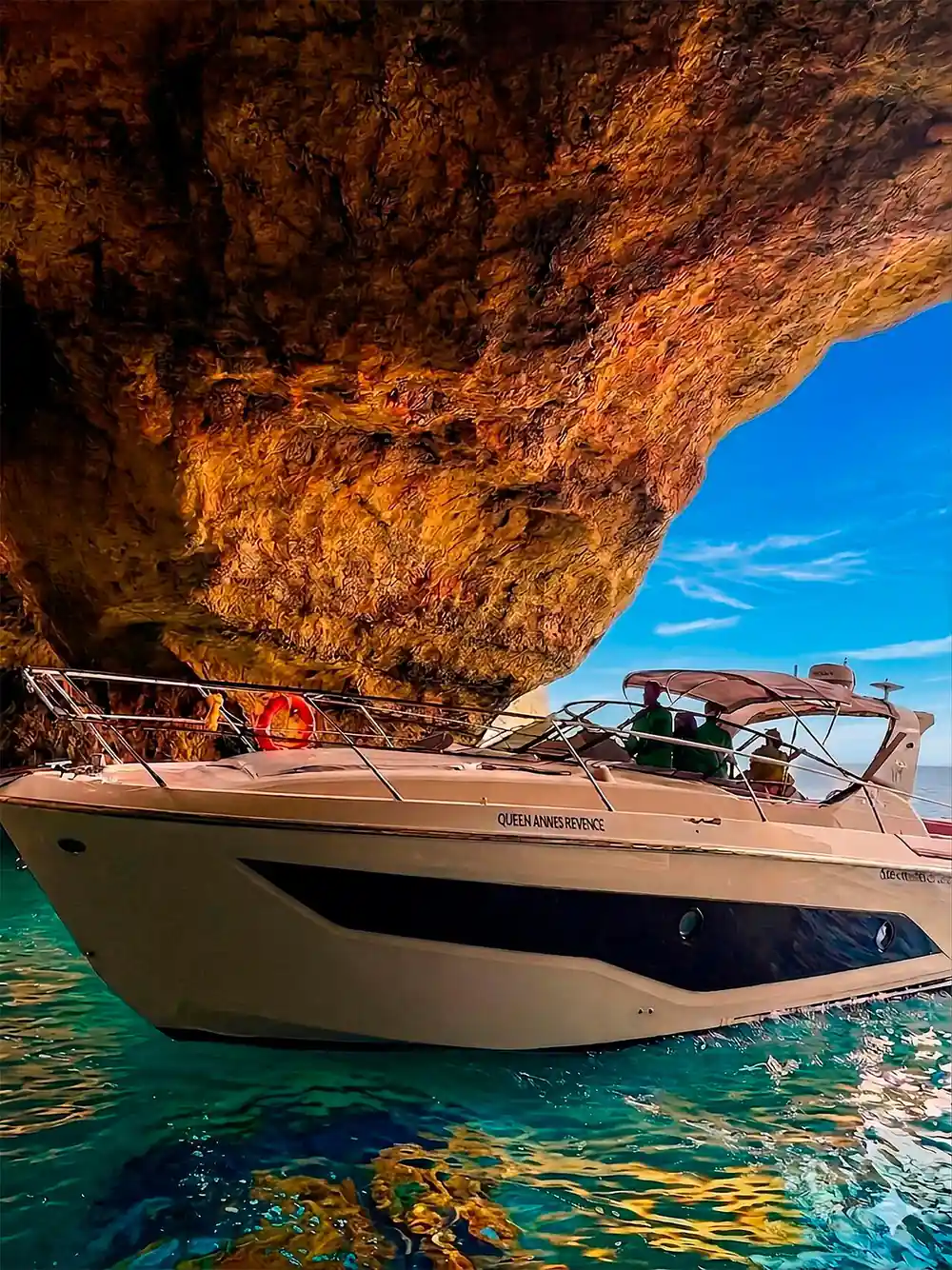
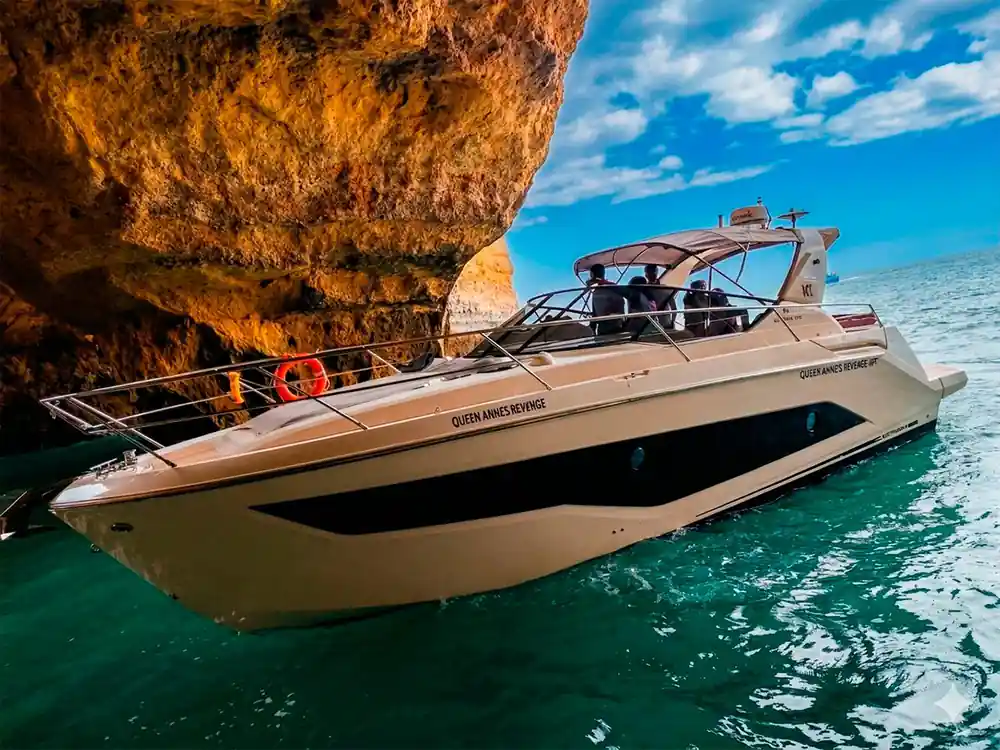
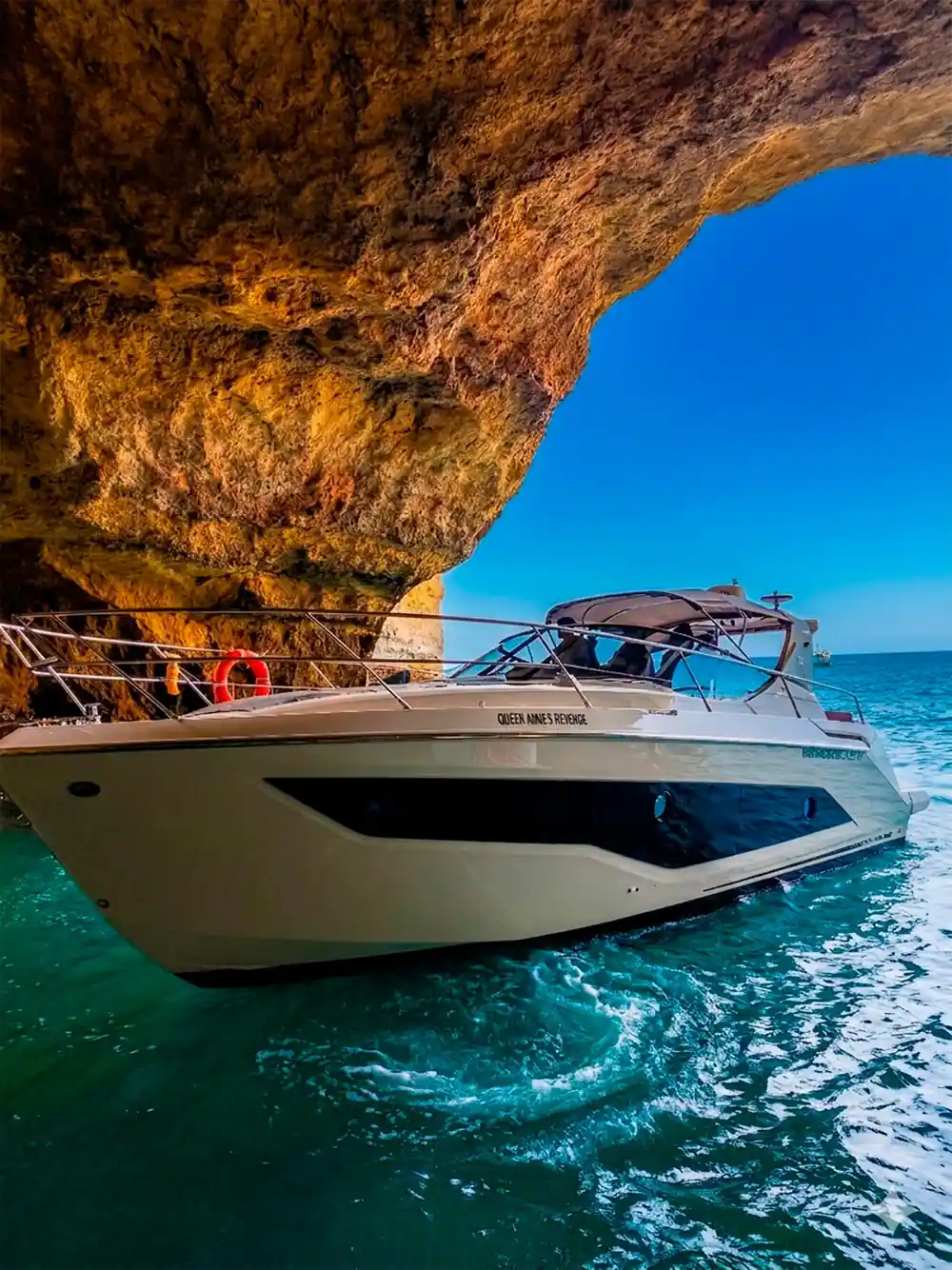
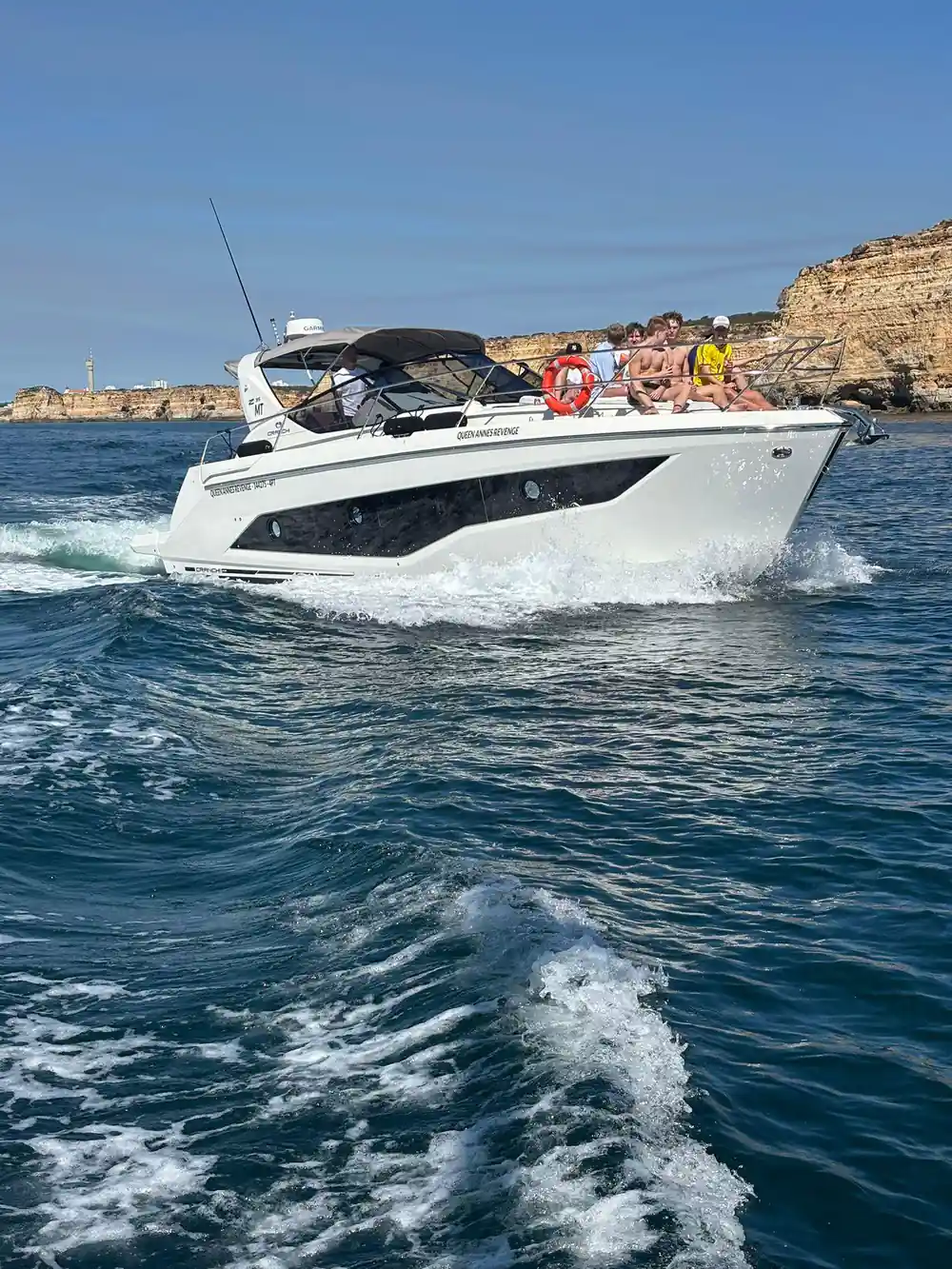
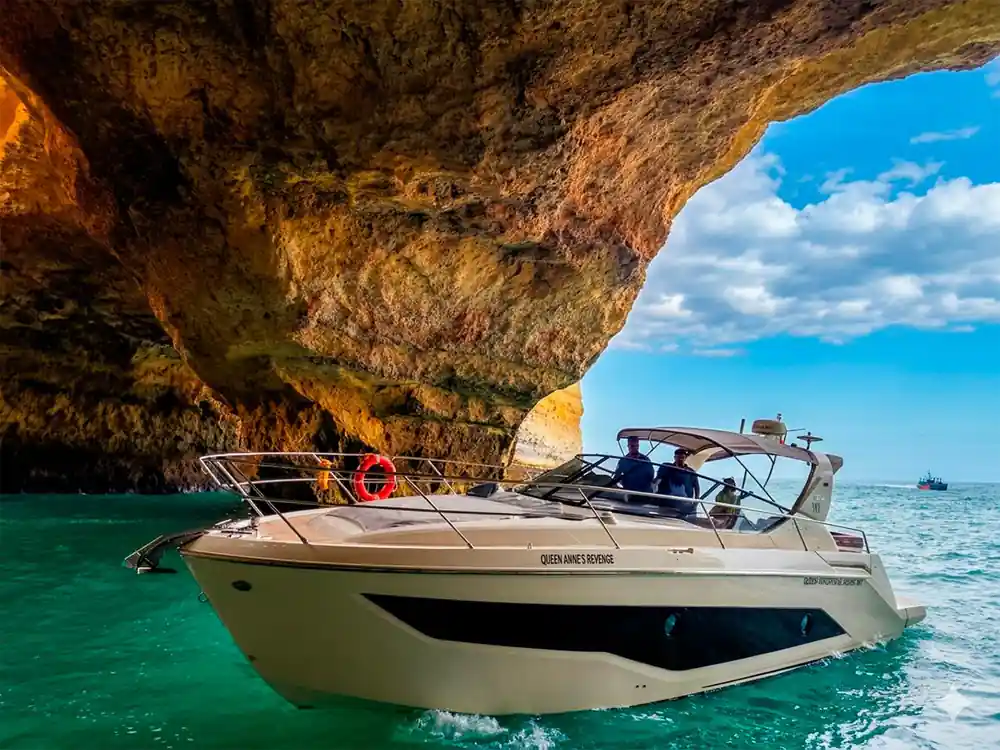
If you want the cave to yourselves, the private option booked here is a Private Yacht Cruise to the Benagil Caves and Marinha Beach, from US$545.[3] It runs for 2.5 - 6 hours as a private group, with a driver who speaks English, French, Portuguese and Spanish, and you can skip the ticket line.[3] The route tracks the coast from Portimão past Praia da Rocha, Carvoeiro and Algar Seco to Praia do Carvalho, Benagil, the Benagil sea cave and Benagil beach.[3] Reserve now and pay later, and cancel free up to 24 hours in advance.[3] It is rated 4.74 from 1,768 reviews.[3]
from US$545
Private Yacht Cruise to the Benagil Caves and Marinha Beach: private group, 2.5 - 6 hours, rated 4.74 from 1,768 reviews.[3]
Kayaks and Paddleboards: Closer to the Water
Paddling in puts you at water level, under the dome, with no engine noise. A kayaking tour with a local guide at Benagil starts from US$19, runs 1.5 hours and is rated 4.59 from 244 reviews.[10] A two-hour guided kayak tour of the caves and cliffs from the same beach starts from US$29 and is rated 4.23 from 2,110 reviews.[11] A guided kayaking tour of the caves and secret spots starts from US$22, runs 2 hours, and is rated 4.58 from 2,665 reviews.[12]
The access rule does not change if you are on a board. Visitors may not disembark onto the beach inside the cave or swim into it, whatever their means of arrival.[1] Guides explain the routine at the briefing: paddle in, sit still, look up, and paddle out. The stretch either side of the cave is where you thread through arches and small grottoes, with the cliffs rising above you and the beaches of the Algarve opening up between the headlands.
When the Sea Says No
The Algarve is a sunny, dry corner of Portugal: the region gets over 3,000 hours of sunshine a year.[13] Air temperatures are mild out of season and hot in summer, with daytime highs usually around 25 to 29 C from June to September and near 16 to 17 C in winter.[6] The sea is cooler than the air all year, at roughly 19-23 C in summer, 18-20 C in autumn, 16-19 C in spring and 15-16 C in winter.[14]
Tides on this coast run through two highs and two lows on most days, roughly twelve hours and twenty-five minutes apart.[15] Wind and swell matter more than sunshine where caves are concerned. On a rough day a skipper or guide may decide the entrance is not safe, and small craft may stay outside or head for a different stretch of coast. Many bookings allow free cancellation up to 24 hours in advance; check the terms before you commit.[3][5] Putting your cave trip early in the holiday leaves room to try again if the sea turns.
Is It Worth Going If You Cannot Land?
Yes, and the cave is really one stop on a coastline that keeps giving. Praia da Marinha, a short hop east, is loved for its natural arches, small coves and golden sand.[16] On land, the Seven Hanging Valleys Trail passes by Benagil Cave and Benagil Beach on the section that runs from Marinha Beach to Carvalho Beach.[17] The clifftop above the cave is part of that path, which makes a good second view of the opening on the same day.
There is wildlife to watch for as well. Off the Algarve, common dolphins are the most-seen species in summer, bottlenose are the only year-round resident pod, and striped dolphins favour deeper offshore water, with sightings of all three peaking from May through October.[18] White storks, which nest at sea, have spread onto the southern coast of the Algarve.[19] The region recorded 5.34 million guests, a 1.8% increase compared to 2024.[20] In summer, reserve your place well ahead.
From prices for Benagil cave trips
All figures are GetYourGuide from prices per person for the listed tours:[3][4][5][9][21]
What Benagil cave trips cost
From prices in US dollars per person for these GetYourGuide listings:[3][4][5][10][21]
When to go to Benagil
Getting inside the cave
Choose your boat
Speedboats, catamarans, yachts and kayaks all reach the cave. Pick by price, duration and how close you want to be to the water.
Book a private yacht
The Private Yacht Cruise to Benagil and Marinha starts from US$545 and runs 2.5 - 6 hours as a private group.[3]
Arrive early at the marina
Check in, collect life jackets and listen to the safety briefing before you leave the marina.
Stay aboard at the cave
Visitors may not disembark onto the beach inside the cave or swim into it, whatever their means of arrival.[1]
Add Marinha Beach
The Seven Hanging Valleys Trail passes by Benagil Cave and Benagil Beach on the Marinha to Carvalho section.[17]
See Benagil Cave from the water on a private yacht
from US$546Reserve now & pay later